
PART 7. Germination. Chapter 34. The germination process.

By one means or another, within the seed, resistance to the intake of water ceases. The embryo begins turning stored starch from the mother back into sugars that it can use to fuel cellular activity. Cells in the embryo are actively dividing now as they fill with water. The seed is germinating.
A crack develops in the softening seed coat. The first root (called the radicle) pushes out through this crack, followed soon by the hypocotyl with the appended epicotyl (the beginning of the shoot)—all this will be discussed in more detail shortly). The water typically enters through the same hole where the vascular bundle had been attached to the seed coat: the hylum (Figure 34.1).
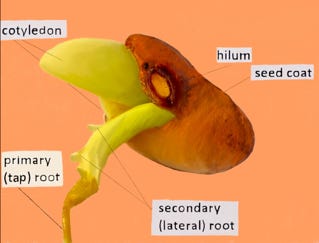
Figure 34.1. Anatomy of a seed. The radical (primary tap root in the diagram) emerges first, and heads downward. Since this is an epigeal species, the hypocotyl (not seen yet) is about to emerge along with the two cotyledons. Digital.
The time between the onset of the rush of water into the seed and the first appearance of the radicle depends on seed size; in particular, there is a maximum amount of water the hydrating seed can take in, and this amount will increase with seed mass. Very small seeds will germinate within about one week from the onset of the process while bigger seeds can take as much as a month.
A drought in the middle of the process can slow it down, thus extending the time required for the germinant to breach the seed coat. But it is worth stressing that the process, once begun, is irreversible. A drying up of the local environment may slow the pace but the seed is not at liberty to somehow reinstitute dormancy so it can re-evaluate its options in a worsening drought (“uh, excuse me, I need a do-over, I was being a bit hasty there. . .”). But as we will see, some seedbeds, like exposed mineral soil, are ideal and will lead to a healthy, optimistic germinant (Figure 34.2).
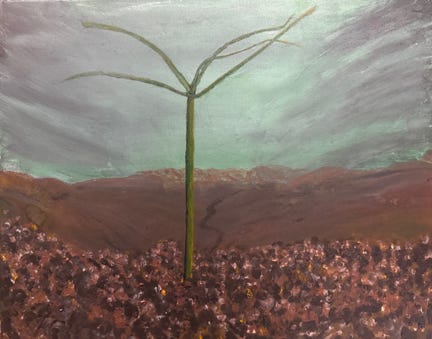
Figure 34.2. The forest floor as a maternity ward. When everything works out, we have the birth of a vigorous germinant. Acrylic.
The process of water imbibition is occurring at a tiny scale; picture the world from the point of view of the seed: a film of water molecules is found around the entry point in the seed coat, and this braided chain may thicken or else thin depending on recent rainfall and relative humidity. The slow drying of the soil since the last rain is the most crucial element in the biography of a germinating seed that has begun to swell with water: with each passing day of inadequate moisture, the expanding tissues in the embryo are increasingly desiccated, stressed. The developing roots are in a race to keep up with the downward retreat of the wetted portion of the soil (Figure Figure 34.3). But even if the mineral soil has ample water waiting for the thirsty root nonetheless the radical has to reach it, and that requires penetrating the seedbed. Seedbed quality, as we explore in the next chapter, is a big deal.
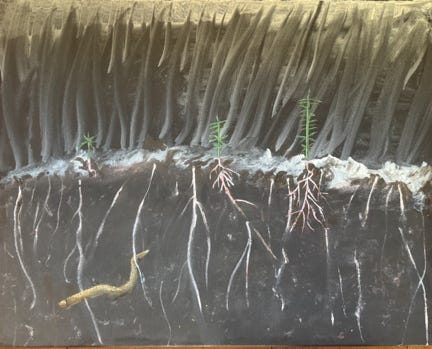
Figure 34.3. Development of the root system of a fir at (from left to right) 3 days, 15 days, and one month since germination began. Acrylic.